How to test your speakers properly
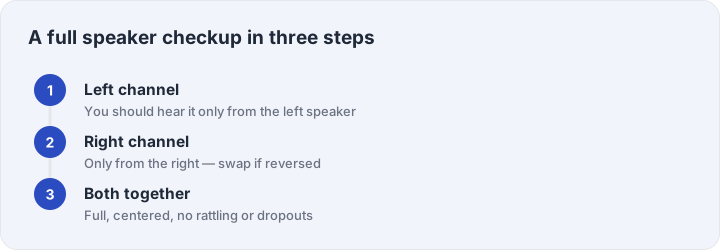
The channel sequence answers the first question — does every speaker play? When the left tone sounds, walk to the speakers that should carry it; on a 5.1 or stereo pair this is the moment you discover a dead satellite, a swapped pair of cables or a speaker that has been silent for months without anyone noticing. The both-channels step then checks the sum: a level drop when both play together usually points at one channel fighting the other, which is a wiring or balance issue rather than a broken driver.
For anything beyond left/right — subwoofers, surround satellites, soundbars with fancy DSP — pure tones are the scalpel. The bass test walks the low end where subwoofers live or die, and the tone generator lets you sweep any frequency slowly, which is how you find the exact note where a cabinet panel starts to buzz. A speaker that plays music beautifully but buzzes at 85 Hz has a loose component that music rarely excites; the tone finds it in seconds.
What each result means
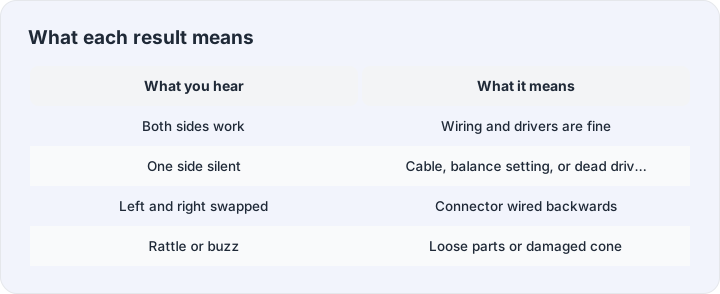
One side silent. Cable, plug or balance — work through the quick checks in the no-sound guide before opening anything. Both sides play but it sounds thin. That is a phase or positioning problem: speakers wired out of phase cancel each other’s bass exactly when both channels play together. Swap the plus and minus wires on one speaker and listen again — thin to full is the signature of a polarity fix. Rattling or crackling on some notes. The crackling guide turns that symptom into a five-minute isolation routine.
Testing is free and local: every tone here is synthesized in your browser the moment you press start. Nothing is recorded, nothing is uploaded, and the volume stays on your side of the screen — start around 60–70% and protect your ears above all.